

| Horizontal style Few objects are so generally identified with African art as the Bamana "antelope" headdress. It is actually a complex object, with tremendous variations in style and technique, but share the same symbolism. The differences are usually attributed to the regional styles set forth in 1960 by Robert Goldwater, whose work relied on museum- based research and the 1934-35 field data of F. H. Lem. Most African sculptures are carved from one piece of wood, but the horizontal style of antelope mask uses two: one for the head and neck, and one for the body. The tji wara society members use a headdress representing, in the form of an antelope, the mythical being who taught men how to farm. The word tji means “work” and wara means “animal,” thus “working animal.” There are antelopes with vertical or horizontal direction of the horns. In the past the purpose of the tji wara association was to encourage cooperation among all members of the community to ensure a successful crop. In recent time, however, the Bambara concept of tji wara has become associated with the notion of good farmer, and the tji wara masqueraders are regarded as a farming beast. The Bambara sponsor farming contests where the tji wara masqueraders perform. Always performing together in a male and female pair, the coupling of the antelope masqueraders speaks of fertility and agricultural abundance. According to one interpretation, the male antelope represents the sun and the female the earth. The antelope imagery of the carved headdress was inspired by a Bambara myth that recounts the story of a mythical beast (half antelope and half human) who introduced agriculture to the Bambara people. The dance performed by the masqueraders mimes the movements of the antelope. Antelope headdress in the vertical style, found in eastern Bambara territory, have a pair of upright horns while in the Southern regions they are generally found with horizontal horns like the example below. The dancers appeared holding two sticks in their hands, their leaps imitating the jumps of the antelopes. Sources: A History of Art in Africa / Africa - The Art of a Continent |
| Examples below for reference purposes - they are not in my collection |
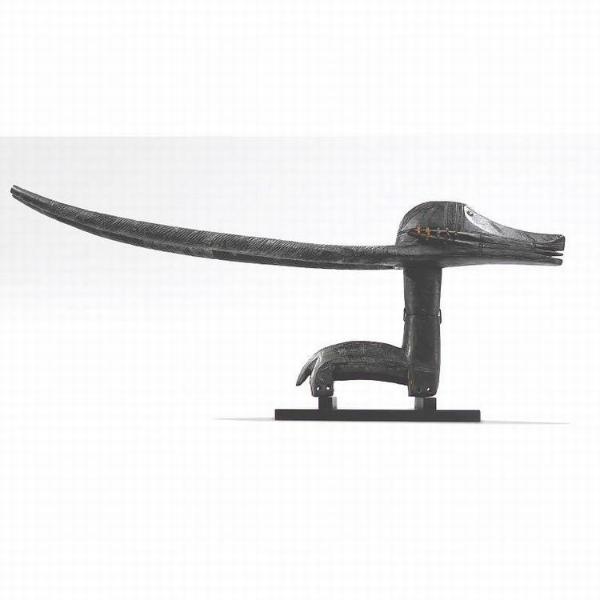
| Sotheby's - New York African, Oceanic and Pre-Columbian Art Auction Date : Nov 11, 2004 Lot 44 : A SUPERB BAMANA ANTELOPE HEADDRESS Description tji wara, Bamako or Beledugu region, of dynamic horizontal proportions, the diminutive arched body tapering to a dorsal ridge with a pointed tail and legs pierced for attachment beneath the elongated neck affixed at the center with metal stays, and supporting the head with a tapering snout and medial ridge bisecting the disc-like eyes and pointed ears, pierced with evidence of cloth attachments, terminating in backswept, slightly arching horns; the whole decorated with fine linear incisions; rich, deeply layered and encrusted, blackened patina. Dimensions length 28 1/4 in. 71.7cm Estimate:$ 15,000 - $ 20,000 Price Realized: $ 0 Provenance J. J. Klejman, New York, January 1974 |
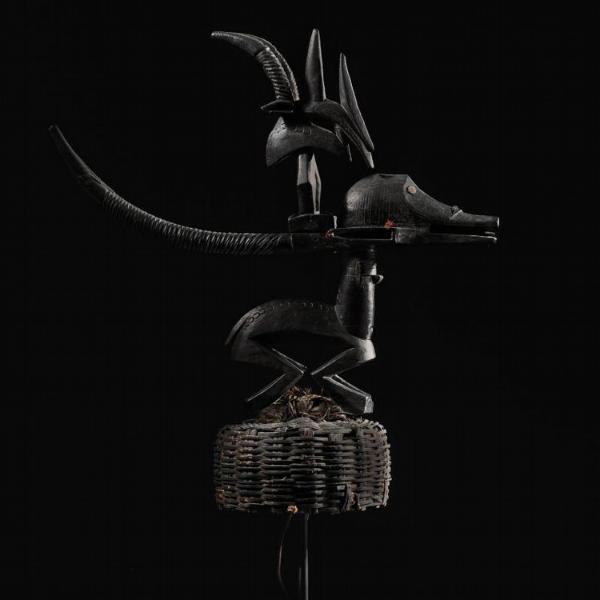
| Sotheby's - New York African, Oceanic and Pre-Columbian Art Auction Date : May 12, 2005 Lot 42 : PROPERTY FROM AN AMERICAN PRIVATE COLLECTION A SUPERB BAMANA ANTELOPE HEADDRESS Description tji wara, of complex composition and refined execution, the female antelope with dramatically bent legs supporting the arching, carinated body leading to the elongated neck with a diminutive pair of breasts, the head affixed to the neck with metal staples, the tapered, slender snout with inset metal eyes, framed by backswept ears leading to upturned, striated horns and supporting an abstract baby at the crown, the whole supported by a woven rattan headdress; exceptionally fine and slightly resinous blackened patina. PROVENANCE Acquired from Pace Gallery, New York, 1996 CATALOGUE NOTE This magnificent female headdress from the Bamako region synthesizes a feeling of graceful, yet dynamic, movement. The metal clamps at the neck create joints that would have allowed the head to sway and add to the movement of the headdress almost independent from the dancer. See Ratton-Hourdé (2001: 36-37) for a related headdress. Dimensions height 20 1/2 in. by length 20 1/4 in. 52.5cm by 51.5cm Estimate: $ 25,000 - $ 35,000 |
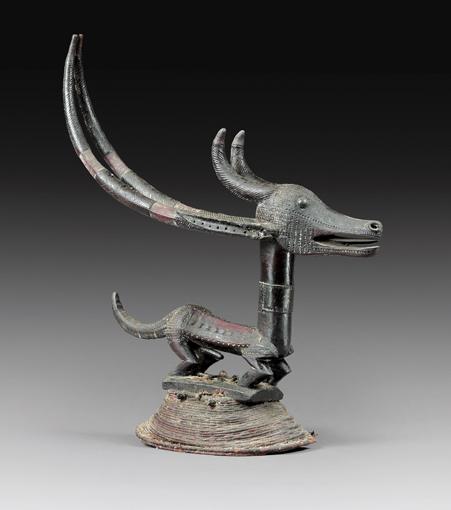
| Sotheby's - Paris Art Africain et Océanien, Auction Date : Jun 15, 2004 Lot 15 : f - CIMIER, BAMANA, MALI Title [A BAMANA ANTELOPE HEADDRESS, MALI] Dimensions long. 46 cm, haut avec la calotte : 50 cm Estimate:€ 10,000 - € 15,000 Price Realized:€ 31,200 $ 37,590 Provenance Maria Wyss, Bâle, vers 1960. |
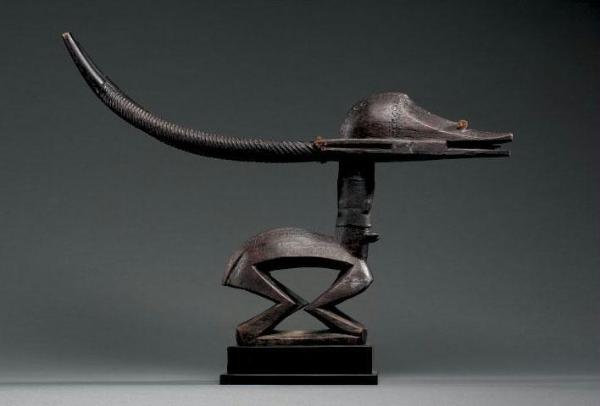
| Sotheby's - New York Arts of Africa, Oceania & The Americas Auction Date : May 17, 2002 Lot 56 : A BAMANA ANTELOPE HEADDRESS Description tji wara, the female antelope standing with bent legs on a rectangular base, the arching, horizontal body beneath the elongated neck with two small breasts at the front and encircled by a leather strip, the large head with pointed face, backswept ears and long arching horns, the left with an indigenous repair of leather at the tip, decorated with red fiber at the nose and ears `A87' in white pigment at the base; varied dark brown patina. Estimate:$ 6,000 - $ 9,000 Price Realized: $ 9,560 Provenance Maurice Ratton, Paris Michael Oliver, New York |

| BAMBARA (BAMANA, BANMANA) Mali |
| The Bambara numbering 2,500.000 million form the largest ethnic group within Mali. The triangle of the Bambara region, divided in two parts by the Niger River, constitutes the greater part of the western and southern Mali of today. The dry savanna permits no more than a subsistence economy, and the soil produces, with some difficulty, corn, millet, sorghum, rice, and beans. Their traditions include six male societies, each with its own type of mask. Initiation for men lasts for seven years and ends with their symbolic death and their rebirth. Nearly every Bambara man had to pass through these societies in succession, until, upon reaching the highest rank, he had acquired a comprehensive knowledge of ancestral traditions. The jo society has become a sort of framework for other initiation society. Until a few decades ago, initiation was obligatory for every young man. Jo initiations take place every seven years, after candidates receive six years of special training. During this time, the young men go through a ritual death and live one week in the bush before returning to the village. There they publicly perform the dances and songsthey have learned in the bush, and receive small presents from spectators. After a ritual bath that signals the end of their animal life, the new initiates become “Jo children.” The korè society is perceived by the Bambara people as the “father of the rain and thunder.” Every seven years a new age-set of teenagers experiences a symbolic death and rebirth into the korè society through initiation rituals whose symbols relate to fire and masculinity. Initiations take place in the sacred wood, where the youths are harassed by elders and the clown-like performers called korédugaw. In their general form and detail, a group of korè masks conveys concepts such as knowledge, courage, and energy through the representation of hyenas, lions, monkeys, antelopes, and horses. In addition there are masks of the nama, which protect against sorcerers. The komo is the custodian of tradition and is concerned with all aspects of community life -- agriculture, judicial processes, and passage rites. Its masks are of elongated animal form decorated with actual horns of antelope, quills of porcupine, bird skulls, and other objects. Their headdress, worn horizontally, consists of an animal, covered with mud, with open jaw; often horns and feathers are attached. Masks of the kono, which enforces civic morality, are also elongated and encrusted with sacrificial material. The kono masks were also used in agricultural rituals, mostly to petition for a good harvest. They usually represent an animal head with long open snout and long ears standing in a V from the head, often covered with mud. In contrast to komo masks, which are covered with feathers, horns and teeth, those of the kono society are elegant and simple. The tji wara society members use a headdress representing, in the form of an antelope, the mythical being who taught men how to farm. The word tji means “work” and wara means “animal,” thus “working animal.” There are antelopes with vertical or horizontal direction of the horns. In the past the purpose of the tji wara association was to encourage cooperation among all members of the community to ensure a successful crop. In recent time, however, the Bambara concept of tji wara has become associated with the notion of good farmer, and the tji wara masqueraders are regarded as a farming beast. The Bambara sponsor farming contests where the tji wara masqueraders perform. Always performing together in a male and female pair, the coupling of the antelope masqueraders speaks of fertility and agricultural abundance. According to one interpretation, the male antelope represents the sun and the female the earth. The antelope imagery of the carved headdress was inspired by a Bambara myth that recounts the story of a mythical beast (half antelope and half human) who introduced agriculture to the Bambara people. The dance performed by the masqueraders mimes the movements of the antelope. Antelope headdress in the vertical style, found in eastern Bambara territory, have a pair of upright horns. The male antelopes are decorated with a mane consisting of rows of openwork zigzag patterns and gracefully curved horns, while the female antelope supports baby antelopes on their back and have straight horns. The dancers appeared holding two sticks in their hands, their leaps imitating the jumps of the antelopes. From the artistic point of view the tji wara are probably the finest examples of stylized African art, for with a delicate play of line the sensitive carvings display the natural beauty of the living antelope. In traditional African societies, a childless marriage is a grave problem. Further, childlessness seems to be the wife’s problem to resolve. Women with fertility and childbearing problems in Bambara society affiliate with gwan, an association that is especially concerned with such problems. Women who avail themselves of its ministrations and who succeed in bearing children make extra sacrifices to gwan, dedicate their children to it, and name them after the sculptures associated with the association. Gwan sculptures occur in groups and are normally enshrined. An ensemble includes a mother-and-child figure, the father, and several other male and female figures. They are considered to be extremely beautiful. They illustrate ideals of physical beauty and ideals of character and action. The figures are brought out of the shrine to appear in annual public ceremonies. At such times, the figures are washed and oiled and then dressed in loincloths, head ties, and beads, all of which are contributed by the women of the village. The size of the statues may vary from 12 inches to 4 feet. The figures are usually with a dignified air. Some have the arms separated from the body, flat palms facing forward, the hands sometimes attached to the thighs. They may have crest-like hairdos with several braids falling on their breasts. In the same style, representations of musicians and of lance-carrying warriors are found. There are also carvings with Janus head. Ancestor figures of the Bambara clearly derive from the same artistic tradition, as do many of those of the Dogon. Rectangular intersection of flat planes is a stylistic feature common to Bambara and Dogon sculpture. There are also reliquary figures in form of a woman, having an oval cavity below the breasts, marionette figures, and others. Source: www.zyama.com |
