
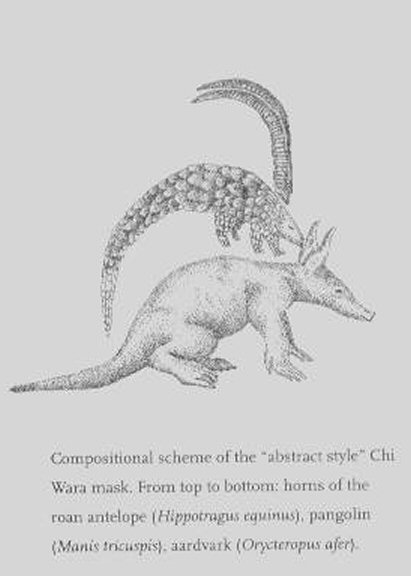
| Abstract Tji wara This headdress represents the comparatively more abstract type of Chi Wara mask; which is found primarily in the Ouassoulou region of the southwestern Bamana area. It shows a typical combination of three different species of animal - the aardvark, the pangolin, and the roan antelope. The base of such headdresses is invariably formed by a representation of the aardvark. Here it is clearly recognizable from the simplified but still relatively naturalistic elongated head, pointed ears, arched body, and bent legs. The structure on the aardvark's back, circumscribed by a nearly closed oval, represents a pangolin in the rolled up position it assumes in defense and to protect its young. This stylized figure is surmounted by two vertical elements and by the horns and long, pointed ears of an antelope. According to Zahan, all three animals are symbolically linked in the Bamana farming community with tilling the soil, including it's sexual connotations. The aardvark and pangolin, especially, are associated with the growth of sorghum, the Bamana's most important grain crop. The aardvark's ability to dig rapidly into the ground and create a network of subterranean tunnels and chambers recalls the men's skill at working the fields, as well as the deep root system formed by the germinating sorghum seeds. The pangolin, in contrast, which lives mostly on the ground and in trees, recalls the windblown stalks of millet, which are stabilized by air-roots anchored in the ground. Sources: A History of Art in Africa and Africa and Africa - The Art of A Continent |
| Examples below for reference purposes They are not in my collection |
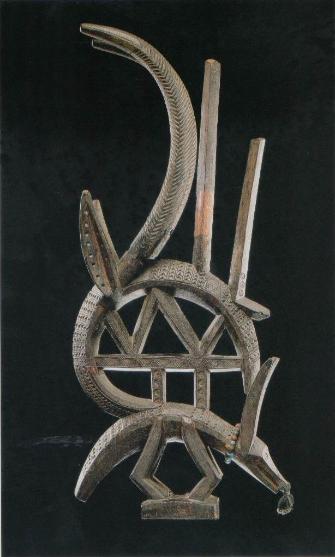
| Abstract Tji-Wara from the book "African Masks from the Barbier-Mueller Collection" |
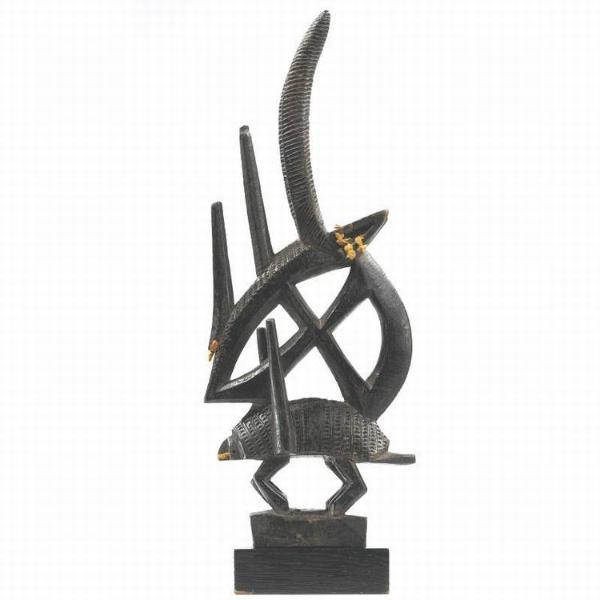
| Sotheby's - New York African, Oceanic and Pre-Columbian Art Auction Date : Nov 11, 2004 Lot 39 : A FINE BAMANA, BOUGOUNI OR DIOÏLA REGION, HEADDRESS Description tji wara, the base pierced for attachment beneath a figure with bent legs and a rounded body with rows of incised motifs folding to a medial ridge, with a small face at the front and a tail at the back surmounted by an openwork mane and gracefully arching head with extended horns and pointed ears with fiber attachments; fine and varied, slightly encrusted deep brown patina. Dimensions height 17 3/4 in. 45cm Estimate:$ 10,000 - $ 15,000 Price Realized: $ 12,000 Provenance PROPERTY FROM A CHICAGO PRIVATE COLLECTION Doctor Gaston Durville, Paris Acquired from Pace Gallery, New York, June 1983 Notes This tji wara represents a composite of the hippotragus antelope and a pangolin. In Bamana mythology, the antelope is the bringer of agrarian knowledge. Likewise, the pangolin, a burrowing animal, knows how to till the soil having witnessed the bringing together of the earth by God (Zahan 1980: 74; quoted in Colleyn 2001: 204). See ibid. 230-233 for related headdresses. |
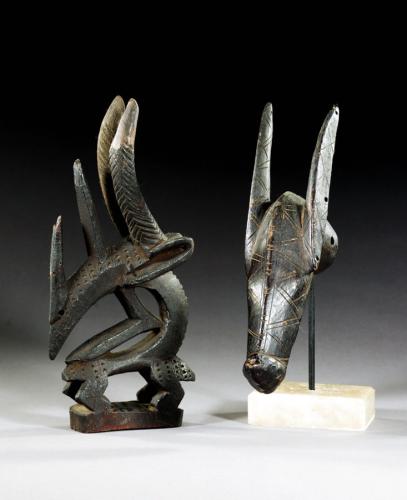
| From a Sotheby's auction in London |
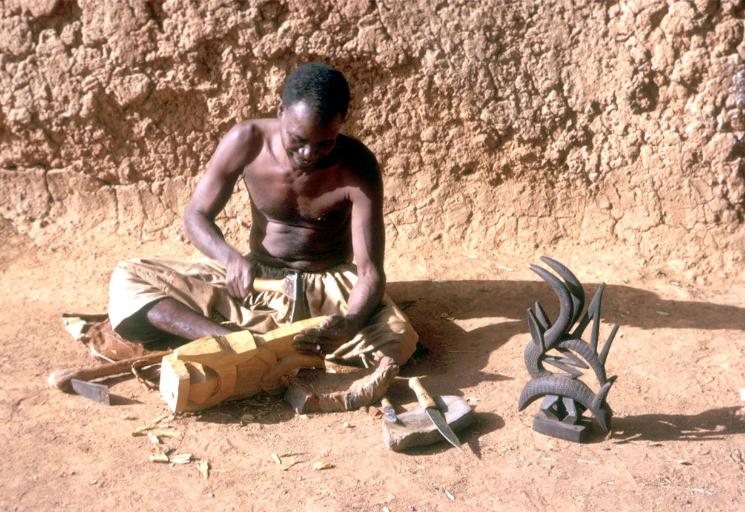
| A Bamana carver making an abstract Tji-Wara Photo source: Eliot Elisofon Photographic Archives |
