
| Noteworthy news in the Native American art world |
| Rand African Art home page Auctions/Exhibitions/More home page Native Arts of the World...in the news main page |
| October 9th, 2006 - Sotheby's sale of The Dundas Collection of Northwest Coast American Indian Art Achieves $7,030,600 (artdaily.com) |

| A MAGNIFICENT TSIMSHIAN POLYCHROMED WOOD FACE MASK Estimate 700,000—1,000,000 USD Lot Sold. Hammer Price with Buyer's Premium: 1,808,000 USD (information on this mask can be found further down in this page) |
"NEW YORK.- Sotheby’s sale of The Dundas Collection of Northwest Coast American Indian Art, the finest known field collection of Northwest Native
material in private hands, achieved $7,030,600, a new record for a sale of American Indian Art at auction, far above its presale estimate of $2.4/3.4 million
and with every lot sold. The unparalleled artistic and historic value of the collection, which had survived in family hands since it was originally acquired by
the Reverend Robert J. Dundas of Scotland in October of 1863, attracted a wide array of bidders from the Canada, the United States and Europe. Among
the masterpieces of Tsimshian art which ranked among the most impressive and best known of Northwest Coast artifacts, was a Tsimshian Portrait Mask,
which sold for $1,808,000, setting an auction record for an American Indian Object. The previous record was set by Sotheby’s in May 2006 when an Early
and Important Upper Missouri River Man's Quilled and Pony Beaded Hide Shirt, probably Blackfoot, sold for $800,000.
The mask was purchased by Donald Ellis of the Donald Ellis Gallery of Dundas, Ontario, Canada who purchased a total of 27 lots in the sale, bidding on
behalf of two Canadian institutions, an American private interest and two members of the Thomson family of Canada. The day after the sale, Mr. Ellis said:
“The Donald Ellis Gallery is extremely thrilled to have been a participant in the repatriation of a major portion of the Dundas Collection to Canada.
Discussions are already underway this morning regarding a public display of this extraordinary group of historical Northwest Coast native art.”
Benjamin Carey, speaking on behalf of his father, Simon Carey, the seller of the Dundas Collection who is also the great grandson of the Reverend Robert
J. Dundas, said: “My father and I are extraordinarily pleased that the bulk of this remarkable collection, which has been our family heritage for 143 years,
will, with this sale, become part of the heritage of the Canadian nation. We look forward to talking to these institutions and exploring how we can work
together on the publication of my great-great grandfather’s letters, journals and other unpublished material, which represents such an incredible historical
resource about early British Columbia and the Pacific West coast.”
David Roche, Sotheby’s Consultant in charge of the sale, said: “It has been one of the high points of my career to preside over the sale of the Dundas
Collection, which is the most important collection of American Indian Art to come to auction in the last 30 years.”
A Rare Tlingit Polychromed Wood Clan Hat, elaborately carved in the form of a frog, a creature which figures prominently in Northwest Coast mythology,
sold for $660,000 (est. $350/550,000). A Rare and Important Northwest Coast Club, Tlingit or Tsimshian, carved from the branch of an elk or caribou
antler with a series of totemic devices, sold for $940,000 (est. $450/550,000). A second Rare Northwest Coast Club, Tlingit or Tsimshian, in the form of a
bird with curving beak, sold for $108,000 (est. $150/200,000). A Tsimshian Polychromed Wood Headdress probably depicting a mosquito, sold for
$340,800 (est. $90/120,000). An Early Tsimshian Polychromed Wood Chief’s Ceremonial Dance Rattle, in the classic form of a flying raven, sold for
$108,000 (est. $40/60,000). A Tsimshian Polychromed Wood Chest, carved in relief with totemic designs, sold for $318,400 (est. $70/100,000).
The Reverend Robert J. Dundas - Traveling in British Columbia on the gunboat H.M.S. Grappler, the Scottish Reverend Robert J. Dundas spent the
morning of October 26, 1863 on the shores of Metlakatla. Here he was shown and acquired a group of Northwest Coast American Indian artifacts
assembled by William Duncan of the church mission at Old Metlakatla. A 250,000-word journal that Dundas kept during his time in British Columbia
between 1859 and 1865 provides unusual documentation about the acquisition of the Collection, and historic and cultural information about the region as
well. His vivid observations of the Native inhabitants, recorded in his journal, bring the objects in the collection to vibrant life. " (Artdaily.com)
material in private hands, achieved $7,030,600, a new record for a sale of American Indian Art at auction, far above its presale estimate of $2.4/3.4 million
and with every lot sold. The unparalleled artistic and historic value of the collection, which had survived in family hands since it was originally acquired by
the Reverend Robert J. Dundas of Scotland in October of 1863, attracted a wide array of bidders from the Canada, the United States and Europe. Among
the masterpieces of Tsimshian art which ranked among the most impressive and best known of Northwest Coast artifacts, was a Tsimshian Portrait Mask,
which sold for $1,808,000, setting an auction record for an American Indian Object. The previous record was set by Sotheby’s in May 2006 when an Early
and Important Upper Missouri River Man's Quilled and Pony Beaded Hide Shirt, probably Blackfoot, sold for $800,000.
The mask was purchased by Donald Ellis of the Donald Ellis Gallery of Dundas, Ontario, Canada who purchased a total of 27 lots in the sale, bidding on
behalf of two Canadian institutions, an American private interest and two members of the Thomson family of Canada. The day after the sale, Mr. Ellis said:
“The Donald Ellis Gallery is extremely thrilled to have been a participant in the repatriation of a major portion of the Dundas Collection to Canada.
Discussions are already underway this morning regarding a public display of this extraordinary group of historical Northwest Coast native art.”
Benjamin Carey, speaking on behalf of his father, Simon Carey, the seller of the Dundas Collection who is also the great grandson of the Reverend Robert
J. Dundas, said: “My father and I are extraordinarily pleased that the bulk of this remarkable collection, which has been our family heritage for 143 years,
will, with this sale, become part of the heritage of the Canadian nation. We look forward to talking to these institutions and exploring how we can work
together on the publication of my great-great grandfather’s letters, journals and other unpublished material, which represents such an incredible historical
resource about early British Columbia and the Pacific West coast.”
David Roche, Sotheby’s Consultant in charge of the sale, said: “It has been one of the high points of my career to preside over the sale of the Dundas
Collection, which is the most important collection of American Indian Art to come to auction in the last 30 years.”
A Rare Tlingit Polychromed Wood Clan Hat, elaborately carved in the form of a frog, a creature which figures prominently in Northwest Coast mythology,
sold for $660,000 (est. $350/550,000). A Rare and Important Northwest Coast Club, Tlingit or Tsimshian, carved from the branch of an elk or caribou
antler with a series of totemic devices, sold for $940,000 (est. $450/550,000). A second Rare Northwest Coast Club, Tlingit or Tsimshian, in the form of a
bird with curving beak, sold for $108,000 (est. $150/200,000). A Tsimshian Polychromed Wood Headdress probably depicting a mosquito, sold for
$340,800 (est. $90/120,000). An Early Tsimshian Polychromed Wood Chief’s Ceremonial Dance Rattle, in the classic form of a flying raven, sold for
$108,000 (est. $40/60,000). A Tsimshian Polychromed Wood Chest, carved in relief with totemic designs, sold for $318,400 (est. $70/100,000).
The Reverend Robert J. Dundas - Traveling in British Columbia on the gunboat H.M.S. Grappler, the Scottish Reverend Robert J. Dundas spent the
morning of October 26, 1863 on the shores of Metlakatla. Here he was shown and acquired a group of Northwest Coast American Indian artifacts
assembled by William Duncan of the church mission at Old Metlakatla. A 250,000-word journal that Dundas kept during his time in British Columbia
between 1859 and 1865 provides unusual documentation about the acquisition of the Collection, and historic and cultural information about the region as
well. His vivid observations of the Native inhabitants, recorded in his journal, bring the objects in the collection to vibrant life. " (Artdaily.com)
| Some of the noteworthy objects from the sale... |
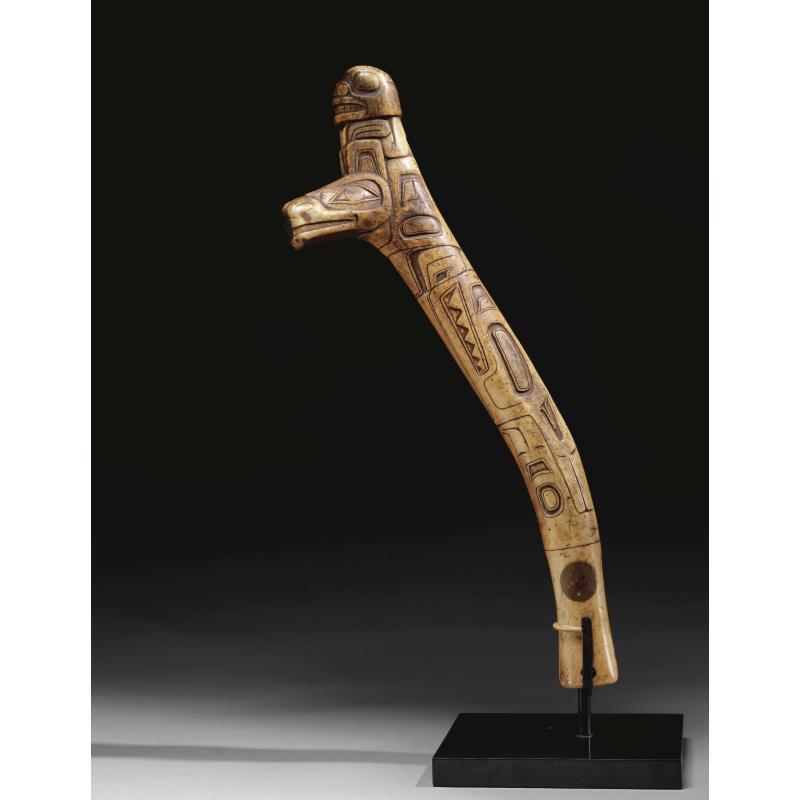
| LOT 35 A RARE AND IMPORTANT NORTHWEST COAST CLUB, TLINGIT OR TSIMSHIAN Estimate 450,000—550,000 USD Lot Sold. Hammer Price with Buyer's Premium: 940,000 USD measurements note length 18 1/2 in. DESCRIPTION of naturally curving form, very finely carved from the branch of an elk or caribou antler, with a series of totemic devices, the projecting “blade” in the form of a wolf, with slightly parted mouth, elongated oval eye rims and large circular pupils, the creature’s tall ears flanking an anthropomorphic figure in a crouching position, wearing a voracious expression, with flaring nostrils and large, animated eyes; a rich golden-turning-to-brown patina overall. CATALOGUE NOTE For related examples see Coe, 1976, p. 145, no. 319, The Sainsbury Collection, University of East Anglica, identified as Tlingit: “In form it is an extraordinary survivor of the ancient Columbia River slave-killers of the rare one-bladed type (see E. Strong, figure 52).” Mauer, 1977, p. 306, no. 479, The University Museum, Philadelphia, NA 3315, identified as Tlingit: “This rare type was said to have been used to dispatch slaves at potlatches, although no evidence supports this claim (see Gunther, 1972, p. 40).” Furst and Furst, 1982, p. 129, pl. 121, identified as Tlingit or Tsimshian, Eighteenth Century or earlier. Fitzhugh and Crowell, 1988, p. 235, no. 313, NMNH 20610, probably Tsimshian: “The form was probably derived from the Athapaskans (fig. 304). Such clubs were once true weapons, and later were used as emblems of chiefly rank. It is said they were sometimes used to kill slaves on ceremonial occasions.” Ames, 1975, p. 36 identified as Tlingit: “This type of club was said to dispatch slaves on ceremonial occasions.” Phelps, 1976, p. 309: “Weapons [used by Northwest Coastal peoples] were mainly those suited to close combat and the Nootka manufactured a specialized form of short, straight club cut from dense-grained whalebone (1558-60, pl 193). These are beautifully balanced weapons and probably of great antiquity, several similar specimens having been collected on the voyages of Cook and Vancouver (Gunther, 1972:209-11). An equally ancient form of Nootkan weapon was cut and ground from basalt in the form of a short hand club, one end serving as a crusher, the other end as a penetrator. Fine clubs made of antler, larger but similar in shape to the shaman’s baton, no. 1461, pl. 181, were prized possessions and several stone axes, set in wood handles carved as heads, were collected from the Nootka on Cook’s third voyage. All of the above-mentioned weapons have on occasions acquired the title “slave killer” but, although slaves were sometimes sacrificed at feasts and funerals in extravagant demonstrations of wealth, it seems likely that only the last-mentioned, structurally weak, weapon was for purely ceremonial use.” Vincent, et. al., 2000, University of Washington Press, p. 355, No. T171. Identified as Coast Tsimshian: “A unique type of war club was made in the northern British Columbia region, apparently from very ancient times. Perhaps originating among the Athapaskan peoples, many such club forms (lacking extensive surface decoration) were made by those groups who traditionally hunted caribou. The shape of the coast-style club appears to have been adopted from the Athapaskan model and may have been carved in individual cases from either caribou or elk antler. By utilizing certain of the branching tines of the strong and broadly spreading antlers of a male elk or caribou, there developed a tradition of making a very intriguing and formidable style of hand weapon that could be engraved over its surface with two dimensional designs of the owner’s family history. The base of one heavy tine is left to extend out from the main shaft of the club at nearly a right angle, into which a stone or iron point could be joined.” |

| LOT 22 A RARE TLINGIT POLYCHROMED WOOD CLAN HAT Estimate 350,000—550,000 USD Lot Sold. Hammer Price with Buyer's Premium: 660,000 USD measurements note height 9 1/4 in. by diameter 13in. DESCRIPTION of classic flaring form, the brim surmounted by a spotted frog or toad in a crouching position, its head upturned, with downturned mouth, thick lips, bulging eyes and arching brows, the lower jaw inset with a mask, masterfully carved with a human face, with lips pulled apart revealing teeth, "laugh-lines" radiating from the nose, and large rounded pupils beneath thick tapering eyebrows, the teeth and eyes inset with plaques of brilliant abalone shell, the whole painted in red, green and black pigments; the interior with fine tool markings and native repair in the form of a wood brace. CATALOGUE NOTE For a related example and discussion see Furst and Furst, 1982, p. 117, pl. 104, identified as Tlingit, circa 1820: “Another type of headgear that passed from generation to generation as supernatural treasure was the elaborately carved conical clan hat representing the group’s principal crest animal. The conical shape was similar to that of woven cedarbark hats, a form no doubt related to the characteristic conical straw hats common through much of Asia. Some hats were topped by a series of cedarbark rings, one each for the great ceremonies sponsored by the wearer and his or her family. A prominent crest figure among the Tlingit is the frog, whose adoption as clan emblem by the ancestors is accounted for in several different family histories (Plate 104). This animal’s importance extends beyond inherited family or lineage property, however, for the frog was also a powerful supernatural helper of shamans and the animal manifestation of an earth deity variously called Mountain Woman, Copper Woman, Volcano Woman, and Weeping or Wailing Woman. The last of these names commemorates her sorrowful lament for her lost child, which, when it appeared by their cooking fire in the form of a frog, was thoughtlessly tossed into the flames by some arrogant young hunters. Piteously crying, Frog Woman searched high and low for her child. Discovering that its bones had been destroyed by the fire so that it could not be brought back to life, she destroyed the village of the culprits with a fiery lava flow which only one woman and her daughter survived.” Also see Jonaitis, 1986, pp. 19-20: “The most important article of headgear owned by the northern Tlingit was the conical crest hat…[which] depicts a frog whose contained position parallels that of the frogs on the frog house posts. The conical crest hat was made either of wood…or of twined spruce-root basketry. When a nobleman wore such a headpiece, his face, painted with family-owned designs, was protected by his crest animal (Oberg 1973: 15; McClellan 1954: 88).” p. 67 “The Tlingit do not consider the crest as simply an image, or a myth, or an object but, instead, as an intricate interconnection of these three aspects. Every crest artwork, regardless of the images depicted on it, expressed the hierarchical structure of Tlingit society and served as a medium of reciprocal exchange. For example, when a family displayed its crest at a potlatch, it was actually presenting visual symbols of its power, prestige, wealth, and particularly its proud history. The more often the group presented its crest objects at potlatches, the more worth these objects accrued – and the greater the prestige of the family that owned them (de Laguna 1972: 451, 458). The actual images of Tlingit crests included celestial bodies, such as the Big Dipper or the moon, natural formations such as glaciers or mountains, and a variety of land, sea and air animals (Swanton 1980: 417-18; de Laguna 1972: 451-57). Despite this wide assortment of crests, according to the Tlingit, the most important ones were those that depicted animals (Emmons, AMNH: notes; de Laguna 1972: 455).” p. 75-76 “The frog of Tlingit crests is not a frog at all, but the …toad Bufo boreas borea, an abundant species that one often sees during the day in summer (de Laguna 1972: 42). The Tlingit are exceedingly frightened of “frogs”; they are horrified at the thought of touching one, and do not even like looking at photographs of them (de Laguna 1972: 42, 831). Emmons (Prov. Arch.: notes) describes how when the Tlingit encounter a frog on a path, they will stop until it has hopped on into the woods. The apparent reason for their terror of this animal is its association with witchcraft. According to Swanton (1980: 457), frogs exude a “slime” from their skin which “is thought to be very poisonous and fatal to smaller creatures” and that witches use in some way to make their victim’s eyes and mouth “bulge out like those of a frog” (p. 470). There are a variety of frog crest myths. One Tluknaxadi story describes how ancestors of this clan were digging the foundation of a house and came across a frog frozen solid. This being came to life when it thawed out, and became a crest of that clan (de Laguna 1972: 273). The Kiksadi have numerous myths about frog, one of which tells how a man out halibut fishing became frightened when he captured a “giant frog” and released it. Later that night, frog returned to that man in a dream, and asked why he had let him go, since the animal wished to give him great wealth (Olson 1967: 39). A different Kiksadi story relates how a woman insulted Frog and was consequently tricked into marrying it when it presented itself to her in the form of a handsome man. That woman was ultimately killed. Another, quite similar Kiksadi myth tells of a woman who insulted frog, married it, and ended up having it killed (Swanton 1909: 53-54, 236-37).” p. 98 “The Tlingit, who organized themselves into hierarchies, organized their artworks into hierarchies as well. In their ranking of headgear, the conical hats assumed a high position on the scale…" p. 111-112 “The frog alludes to another event in Ganaxtedi history, but one that occurred in the relatively recent past; perhaps as late as the early 19th century. Apparently, when this clan arrived at Klukwan, those who were to become the members of the Frog house settled into a “temporary” structure. Although other houses already owned assortments of emblems in addition to the raven, the Frog house did not. To rectify this lack, one of their members went on a voyage to the south in search of an additional emblem. After traveling about a good deal, he arrived at Sitka where he met his grandfather who happened to be a Kiksadi, which is another prestigious raven clan. One of the principal crests of the Kiksadi was the frog, which had been obtained in remote times when an ancestor of that clan had encountered a frog that provided him with wealth. When the grandfather asked his grandson what crest he desired, the latter answered that Frog would please him greatly. The Kiksadi then presented his Ganaxtedi visitor with a small frog carving that signified his right to use that image in his art. When the Klukwan man returned home, he had several artworks made depicting this new crest, including the four Frog posts and two Frog hats; at this point, the principal clan emblems of the Frog house were completed and the structure was properly dedicated.” Also see Collins, et. al., 1977, p. 167: “…as the Tlingit moved up through southeastern Alaska, their clans continued to acquire new crests. A common theme running through all of these newer crest acquisitions is a continuing interaction with anthropomorphized animals who were either insulted or befriended. In many respects Tlingit art may be seen as a representation of social organization. This is most clearly seen in Tlingit moiety and clan crests. Tlingit society was divided into two matrilineal, exogamous moieties. These moieties were known among the northern tribes as Raven and Eagle, whereas among the southern tribes, Eagle was replaced by Wolf. In a matrilineal society, descent is reckoned exclusively from a common ancestress. Every Tlingit is by birth a member of his or her mother’s clan and moiety. The two Tlingit moieties may be seen as marriage classes and each one contained about thirty-five matrilineal clans. These clans were scattered throughout the fourteen Tlingit tribes. Each clan of matrilineal related kinsmen owned an inventory of crests, house names, personal names (that were really inherited titles), songs and dances. The minimal unit of a clan in any given tribe was a named house or lineage. Clansmen of the Raven moiety had to marry non-Ravens and vice-verse. Some of the most frequently represented crests of the Raven moiety are the raven, hawk, puffin, sea gull, land otter, mouse, moose, sea lion, marten, whale, dog salmon, silver salmon, coho salmon, sculpin, starfish, frog and wood-worm.” For other related examples see: Mauer, 1977, p. 307, no. 482, Museum of Natural History, Princeton University, PU 5144, identified as Tlingit; Duff, 1981, p. 210, Fig. 1, National Museum of Man, Canada, VII-C-91 identified as Tsimshian and p. 211, fig. 3, National Museum of Man, Canada, VII-C-1768, identified as Tsimshian. |
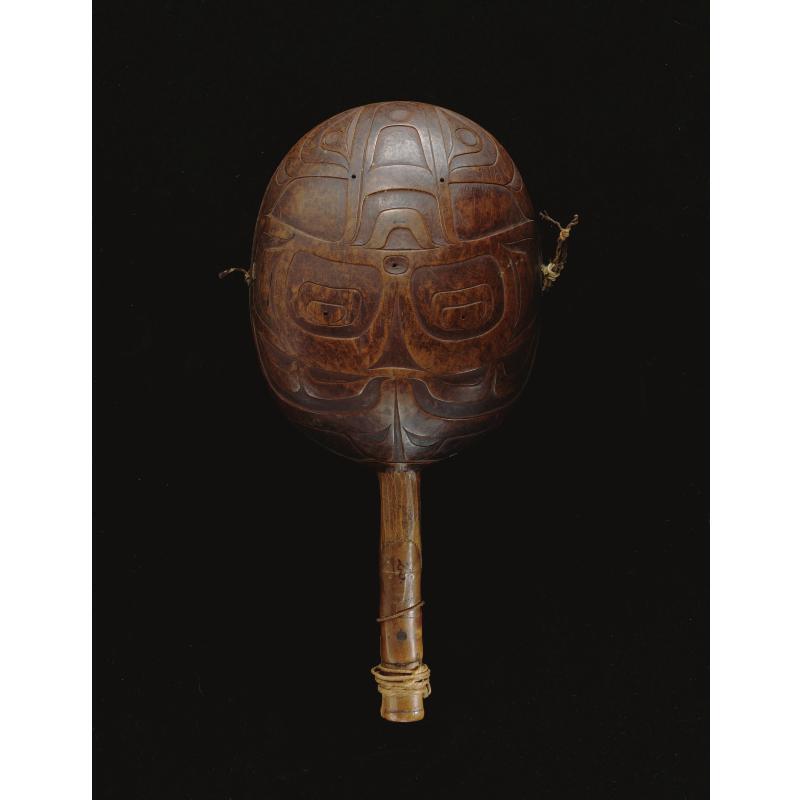
| LOT 11 A FINE TSIMSHIAN SHAMAN'S RATTLE Estimate 80,000—100,000 USD Lot Sold. Hammer Price with Buyer's Premium: 430,400 USD measurements note height 11in. by width 6in. DESCRIPTION carved in two sections, with a slender cylindrical handle joined by a wood peg and wrapped in fiber cording, the oversized compressed globular head carved on both sides in shallow and sunk relief with stylized crest emblems and formline details, perforated numerous times and tied at the sides with sinew; the whole with a rich, dark brown patina. CATALOGUE NOTE For a discussion of globular rattles see Wardwell, 1996, p. 239: “Although some round rattles were made for potlatch and secret society ceremonies, the majority were used by shamans. Guédon (1984b, p. 211) describes Tsimshian shamans’ "round wooden rattles with or without figures carved on them"; Swanton (1908c, p. 464) refers to the "oval rattles such as Haida shamans always employed"; Holm (1987b, p. 128) writes that among the Kwakiutl "globular rattles were reserved for shaman’s work"; and, speaking of the Tlingit, Jonaitis (1986, p. 30) states that "another rattle, owned only by shamans, was the globular type." For a comparable example also see p. 248, no. 367, National Museum of the American Indian, Washington, D.C., 9/7995. Also see Vincent, 2000, pp. 356-57, no. T173, for a comparable rattle identified as Coast Tsimshian. |
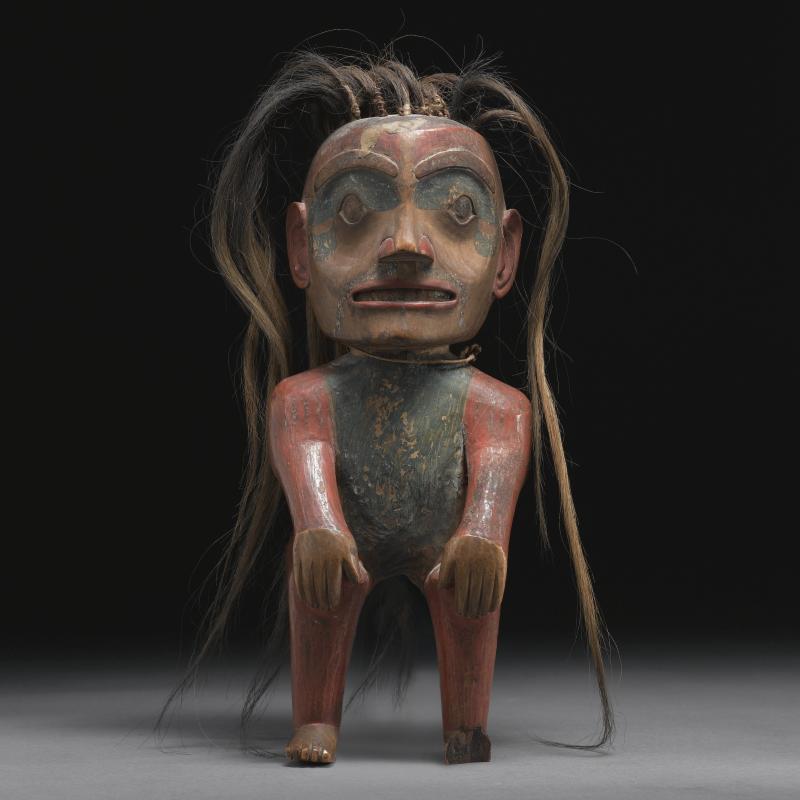
| LOT 19 A TSIMSHIAN POLYCHROMED WOOD SHAMAN FIGURE Estimate 25,000—35,000 USD Lot Sold. Hammer Price with Buyer's Premium: 251,200 USD MEASUREMENTS height 11in. DESCRIPTION in a crouching posture, with hands on knees, hollowed back, mask-like head with bared lips, moustache and ceremonial markings on the eye frames and forehead, the crown inserted with tufts of human hair. CATALOGUE NOTE For a discussion of dolls see Wardwell, 1996, p. 309: “The Tlingit made a number of male and female figures similar to dolls about which there is conflicting information. Because they are often shown with long hair and dressed in shamanic costumes, they most probably represent shamans themselves. Many are also accompanied by miniature masks, headbands and tunics that were kept in small boxes similar to those full-size examples used by shamans for storing their paraphernalia. [Shaman figures]… may have been used to maintain the power of the shaman and, when left with the patient, to represent him after he had completed his performance, as Holm (1973, p. 117) suggests was done with amulets. A crudely carved Tsimshian figure in the Canadian Museum of Civilization in Ottawa (VII-C-1149), for example, made about 1900 by the shaman David May, was said to have had powers similar to his own and to have been left with patients to effect cures.” Also see p. 314, No. 474, for an example in the collection of the Canadian Museum of Civilization, VII-C-1149, identified as Tsimshian; p. 316, No. 476, for an example in the collection of the National Museum of the American Indian, Smithsonian Institution, Washington, D.C., I/4170, identified as Tsimshian; and p. 318, No. 481, Royal British Columbia Museum, Victoria, 1566 identified as Tsimshian. |
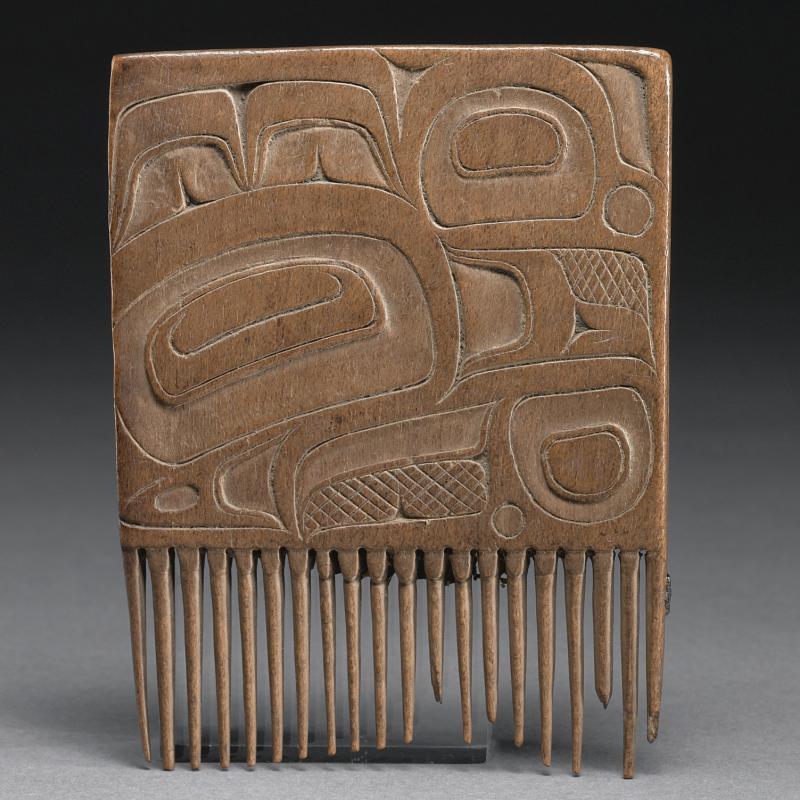
| LOT 23 A TSIMSHIAN WOOD COMB Estimate 10,000—15,000 USD Lot Sold. Hammer Price with Buyer's Premium: 204,000 USD MEASUREMENTS height 4 1/2 in. by width 3 1/2 in. DESCRIPTION of classic form, the large rectangular panel very finely carved in relief on each side, with formline designs, representing a bird, perhaps a raven, the downturned beak incised with cross hatching. CATALOGUE NOTE For a related example and brief discussion see Phelps, 1976, p. 323 and p. 308: " ...special combs were used for grooming, although they were not worn as ornaments (Drucker, 1955: 90)." Also see Wardwell, 1996, p. 208, no. 302, for a comparable in the American Museum of Natural History, New York, 19/448 and Brown, 1998, p. 79, no. 4.21, identified as Haida or Tsimshian: "The design and style of this delicate comb is comparable in formline concepts and relative complexity to that of the large chest panel or bent-corner bowl." |

| LOT 12 AN EARLY TSIMSHIAN POLYCHROMED WOOD CHIEF'S CEREMONIAL DANCE RATTLE Estimate 40,000—60,000 USD Lot Sold. Hammer Price with Buyer's Premium: 108,000 USD MEASUREMENTS length 12 3/4 in. by height 5 1/2 in. by width 4 1/4 in. DESCRIPTION of classic form with a slender cylindrical grip, very finely carved with an avian creature on the underbelly, with pronounced hooked beak and typical formline details, the body carved in the form of a flying raven, holding a small circular medallion in its slightly parted beak, probably a representation of the sun, its head thrust sharply upward with openwork ears supporting the large rectangular head of a shaman reclining on its back, with attenuated angular limbs, and hands wrapped around the splayed legs, his highly stylized mask-like face with a short tongue projecting into the mouth of a small frog, held in the long narrow beak of another bird-like creature, probably a kingfisher, with a flattened backswept crest; the whole with blue, black and crimson red painted details against the natural ground. CATALOGUE NOTE For a discussion of raven rattles and a comparable example see Jonaitis, 1988, p. 74, pl. 25, identified as Tsimshian: "During their celebrations, the Northwest Coast Indians performed elaborate dances accompanied by percussive music. One of the most exquisite instruments…was a rattle collected from the Tsimshian. The body of this rattle represents Raven, a mischievous and powerful mythological being. Some conjecture that this bird is in the process of performing one of his most admirable acts: stealing the sun. It seems that prior to this event, a malevolent creature, unwilling to share the sun’s warmth and light with humankind, kept the celestial body hidden in a box. Raven tricked this selfish being into letting him into the box, and he quickly picked up the treasure with his beak and flew away. On the rattle, a small reddish object can be seen in the raven’s mouth: that is the sun which is about to be spit into the sky to illuminate the world. Carried by the elite at feasts and rituals, these raven rattles were highly prized objects of considerable aesthetic merit to the Northwest Coast Indians." |

| LOT 50 AN UNUSUAL HAIDA ARGILLITE PIPE Estimate 4,000—6,000 USD Lot Sold. Hammer Price with Buyer's Premium: 16,800 USD MEASUREMENTS length 5 1/2 in. by height 2 1/2 in. DESCRIPTION the (fragmentary) rectangular shaft mounted by a stylized bird, with a scrolling beak and streaming feather crest, the beveled bowl inlaid with pewter, very finely carved overall with formline decoration and a series of cross-hatched panels. CATALOGUE NOTE For a discussion of argillite pipes see Brown, 1998, pp. 94-96: "The earliest argillite carvings clearly emulate the established sculptural styles of wood, ivory or bone, and goat horn, through the freedom offered to the carver by the fiberless, homogenous composition of argillite appears to have been quickly realized by the ingenious Haida artists. Argillite is soft enough to shape easily with knives made for wood, or with gravers designed for silver, ivory or bone (which are notably harder). The consequent ease with which a carver can shape out complex figures and execute delicate piercings is balanced nonetheless by the artistic control and restraint necessary to refine the precise definition of sculptural and two-dimensional forms. Personal experience has demonstrated that even a carver’s own heartbeat can interfere with the clean execution of a fine line in this smooth and responsive medium. As in most old Northwest Coast work (regardless of medium), the final surface of argillite carvings is often refined with sharp tools in ever-finer strokes and patterns that are visible on close inspection, and which allow appreciative viewers to visualize the finishing movements of the carver’s hands. ...argillite pipes...evolved...,from about 1825 until 1870, when panel pipes utilizing Haida motifs and also the Euro-American ship types apparently ceased being made (Wright 1977: 104). As the market for the carving of pipes in argillite expanded, so did the concept of the pipes as panels of sculpture. As time passed, argillite carvers began to minimize the functionality of pipes and to emphasize their delicate pierced-panel format. In later examples…the panels became much thinner. The bottom edge became straight and flat, and the bowl and stem-hole of the pipes often assumed the form of vestigial, small-diameter drillings not truly functional as pipes for smoking." |
| LOT 18 A MAGNIFICENT TSIMSHIAN POLYCHROMED WOOD FACE MASK Estimate 700,000—1,000,000 USD Lot Sold. Hammer Price with Buyer's Premium: 1,808,000 USD MEASUREMENTS height 7 3/4 in. by width 7in. by depth 4 3/4 in. DESCRIPTION wearing a trance-like expression, with chin thrust slightly forward, downturned mouth, lips parted to reveal upper teeth, aquiline nose, pronounced high cheekbones, naturalistic ears, and open eyes with thick rims beneath arching brows, the whole painted in black, rich green, and vermillion red pigments against the natural ground, with an abstract design, probably representing a crest or shaman spirit, remains of applied fur around the mouth, below the ears and on the forehead, the periphery pierced twice behind the ears and tied with hide straps for wear; the surface with a shimmering patina from the graphite-laden paints. CATALOGUE NOTE For information on the early collection history of Northwest Coast masks see Holm and Reid, 1975, pp. 13-14: “Most of the fine, old pieces...were picked up by sailors between 1778 and 1830 and taken back to England or Boston to become the delight of antiquarians and the wonder of schoolboys. By 1820, the demand for curios had created a souvenir industry. Great quantities were turned out. The Northwest Coast people had known luxury during the height of the sea-otter trade and were reluctant to give it up. Curios were a poor substitute for sea-otter pelts, but there was little else to trade. The first serious collector on the Northwest Coast was Captain James Cook who gathered ethnographic materials as part of his general fact-finding endeavors... in 1778.” Also see, King, 1979, pp. 23, 26 – 31: “A very large percentage of the surviving portrait masks [were] collected before 1870, and their carving and sale must be understood in the context of the rapid disintegration of Indian institutions at this time. Masks were collected in several different ways before 1870, and these activities determine what is known of their manufacture and significance. In the earliest period masks were traded, for instance, to Cook because the Nootka were anxious to obtain metal. With the extension of trade it seems probable that only ceremonially insignificant items were regularly traded to American and European sea captains. No doubt important sea captains were still able to obtain, or were presented with, objects considered significant by the Indians. The Canadian artist, Paul Kane, made sketches showing masks from a number of tribes at Fort Victoria in 1847; George Catlin perhaps acquired the human face masks for his London exhibition of the 1840s from a similar trading company source. Another sailor who was able to purchase masks on the Columbia River, 100 miles west of Fort Vancouver, was Lieutenant Charles Wilkes who led the United States Exploring Expedition of 1838 – 42. Under those circumstances it is not surprising therefore that masks of this early period are poorly understood by anthropologists. It is this, and the sensitivity of the carving, which has given rise to the frequent claim that many of them are portraits. Franz Boas, the greatest anthropologist of the Northwest Coast, arrived in 1886 with photographs and drawings of masks whose significance he wanted to ascertain. He discovered that it was seldom possible to find the exact significance of individual masks unless he visited the village from which they came. This was partly because masks were made for the use of particular individuals who gave them their meaning, and partly because masks were traded from village to village and tribe to tribe and in this process their meaning was liable to change or become lost. It was the masks... on which the greatest ingenuity, care and attention were lavished. Of the many different types it was those depicting the human face which were at once the simplest and the most sophisticated. They are simple because the subject-matter is straightforward, and because the technical skill of the carving is apparently uncomplicated. The sophistication of human face masks lies in the understanding of the human form and the artist’s ability to communicate this understanding in a variety of dramatic ways. Another unusual aspect of these abstract designs when used on masks is that they are rarely symmetrical. This decorative scheme was formalized by the northern tribes, the Tlingit, Haida and Tsimshian, but its origin probably lies in a little-known earlier art style common to the whole of the Northwest Coast. During the nineteenth century the Southern Kwakiutl, and to a much lesser extent the Nootka, began to adopt the intellectualized design principles of the north. Facial painting on masks usually represented designs of crests and shamans’ spirits. Among the northern Northwest Coast Indians crests were inherited from real or mythological ancestors in the form of animals. A chief and his family would have a large number of crests, but only the chief would be entitled to wear them all. Most Tlingit human face masks are connected with shamanism rather than with crests and the painting symbolizes, in a very abstract way, an animal or other natural spirit helper. Facial painting, therefore, when transferred onto masks, is another possible way in which portraiture and representation may have been realized.” Also see Macnair, et. al., 1998, p. 60: “By far the majority of masks collected on the Northwest Coast until about 1850 represent a human face or an animal in anthropomorphic guise…. To date, most of those depicting the human face have been categorized as portrait masks, a term that implies the likeness of the visage of a real person is intended. The sense of skin and underlying musculature evoked by the mask...evokes this as a possibility. Nisga’a, Gitxsan and Tsimshian masks used in the Naxnox dance series are dramatizations of spirit beings. Many of the masks represent human frailties such as conceit..., pride, stupidity, avarice, sloth and arrogance. Some categorize social groups such as old people, members of rival tribes, intruders or white men. Others depict an array of animals and celestial objects.” For information on the genesis of the mask carving tradition see Malin, 1978, p. 41: “The earliest European explorers have left their impressions of the masks and their usage among the Northwest Coast Indians. Since the art was well developed by then, we can assume that masks had been produced for a very long time. So when we speak of their beginnings, we are peering back into prehistory, and there are no records to help us.” pp. 13 – 14 “The flood of trade items which reached the coast in the late eighteenth and early nineteenth centuries gave the Indians easy access to knives, nails, chisels and axes made of iron. Other materials such as canvas, cloth, buttons, and paints also became available. Traditional, laboriously-made tools for carving were gradually discarded in favor of superior implements or novel materials. Metal tools facilitated carving to the point where demand on the artist’s productivity increased, given the competitive nature of the societies. Artists were spurred to innovate, to astonish and awe the viewers of a patron’s history at an important potlatch. Each effort pushed back horizons of the artist’s perception, and they revealed with increasing clarity and skill the nuances of their assignment. Metal tools unleashed the artist’s capacity to produce more easily, to express bold new ideas, and contrive experiments, which fueled the fires of competition between rival tribes. More and more apprentices flocked to established carvers to take up the challenge of mask making. A veritable explosion of masks followed. Northwest Coast society crystallized into a culture of specialists: those who carved dugout canoes, others who carved totem poles, those who specialized in box making, household items, ceremonial paraphernalia, and masks and costumes." For information on the use of masks see Wardwell, 1996, pp. 6-7: “Often, however, when faced with certain undocumented masks, human and animal sculptures, storage boxes and other objects, we can only make educated guesses as to whether they were made for use by shamans. At times, the intended use of an object can be hypothesized with some certainty. For example, the appearance of specific motifs or animal forms often associated with shamans, such as the depiction of skeletal elements, the land or river otter, the bound witch, the devilfish, and the oystercatcher, can be a reliable indicator. Shamanic connections are also clearly suggested by some odd facial expressions on anthropomorphic masks, including those that depict a trancelike state or represent incipient death, often by drowning. The eyes are shown half closed and looking upward, with the irises partially concealed by the lids, the jaw is slack and a swollen tongue protrudes from a partially open mouth. Another clue to shamanic function is the fact that the eye holes on many of the masks used by Tlingit shamans were not cut through. The shaman often did not actually have to see, as he relied on his assistants to guide him during some performances, while at others he danced within a small prescribed area (de Laguna, 1972, pt. 2, p. 692; Vaughan and Holm, 1982, p. 91, no. 55).” pp. 80-82 “A number of very realistic depictions of the human face are found among these masks. Some may well be portraits (Holm, 1987b, p. 232), particularly the early, naturalistic, and archaic examples collected by Emmons. These are often accompanied with his notes stating that some of the material recovered had passed through as many as five generations of shamans. These objects would date from the first quarter of the nineteenth century if not earlier. Other masks in this series are idealized depictions of young men and women. Numerous masks of highborn women wearing labrets exist from this period, and most are painted with asymmetrical designs that show the sort of face paintings that were applied on ceremonial occasions. As mentioned, another series of masks represents the onset of a trance state, with obvious reference to the activities of a shaman. In this group are also those showing incipient death by the use of such stylistic conventions as a thick, protruding tongue, closing eyes and a limp jaw. Those that bear bleeding wounds on the forehead and cheeks depict dying warriors, and may have been used to tell of the success of shamans who had accompanied war parties. Other masks show men in the process of drowning, a death that was dreaded above all others, because if the body was lost and thus not cremated, the soul was fated to wander the earth forever (Gunther, 1972, p. 141). Many of these masks have the same features as those representing trances, although one group actually depicts the various stages of the change from a human to a land otter. Shamans themselves are represented by those masks depicting trances and by some examples in which the lips are pursed or the mouths are opened in different positions. The pursed lips could suggest the sucking and blowing that the shaman would perform while curing. For the shaman, the use of the mouth was more important in curing than the laying on of hands (Guédon, 1984b, p. 206). Some masks of shamans with pursed lips are said to have been used to blow the swansdown used in shamanic performances (Emmons, n.d., E396). Such an expression could also represent whistling, which was another method of communication between a shaman and a soul and was sometimes used to summon spirits. Other mouth positions show shamans in the act of talking and singing as they performed.” For more information on Tsimshian mask carving and the use of masks by the Tsimshian see Carlson, 1976, p. 42-43: “Wingert expressed the character of Tsimshian mask sculpture very well when he wrote, “There is also a strong expression of fleshy forms and tightly drawn surface skin over these bony structures.” The effect of the large orb pressing against the eyelid is really beautifully expressed…. Some of the specific formal details characteristic of Tsimshian sculpture are the pyramidal cheeks, the wide, rounded orb and the eyelids without defining painted or carved rim. A profile of a typical Tsimshian mask…shows the aquiline nose, smoothly rounded forehead and forward thrust of the chin, which is relatively short vertically. The three cheek planes converging on a common point are also characteristically Tsimshian.” Also see King, 1979, p. 77: “The Tsimshian used masks in much the same way as the Haida. Masks were worn at feasts given by chiefs, in ceremonies performed by shamans and in the performance of winter dances which were almost certainly acquired from the Northern Kwakiutl." And Malin, 1978, pp. 49–51: “A particularly interesting use of ritual masks is found in the secret societies associated with the Tsimshian, northern Kwakiutl, Bella Coola and southern Kwakiutl tribal divisions. Membership in such organizations cut across clan or lineage lines making many people eligible to join them. Ceremonies were centered around winter activities and were strong unifying forces within the tribe. A proliferation of orders and sub-orders of these societies developed, each with masks associated with special uses and kinds of performance. There were healing societies made up of shaman, there were conjuring societies, war societies, and societies for inducting young people or adults as new members. The initiates in all secret societies were induced into trance-like states for communion with spirits, some of which were terrifying. …of far greater significance were those masks that belonged to the shaman, the specialists involved in the arts of healing the sick. Shaman or Indian doctors cured illness, and maintained the equilibrium of the tribe in times of acute crisis. Each shaman’s paraphernalia included masks which he used to cure…. Each shaman had his own curing techniques, rituals, masks, even songs that helped to heal. The masks often portrayed special beings, sometimes known as helpers, in the healing arts. No two shaman used the same masks because their powers differed. They appeared to have carved their own rather than hiring a carver specialist to create the mask for them. Tlingit, Haida, and Tsimshian tribal groups commonly employed the masked shaman for healing rituals…." And, finally, Brown, 2000, pp. 50–51: “Masks were seen as repositories of supernatural power. This is the case of masks used by Tlingit shamans (shamanic art is prominent in the northern province, especially among the Tlingit). Masks carved to represent animal, bird and human spirits that were controlled by a shaman, and whose power gave him the ability to cure illness, predict the future, or counteract the power of sorcerers are among the most dramatic examples of Northwest Coast art. Other shamanic objects – rattles, amulets, robes and headdresses, for example – are equally evocative and powerful. Haida and Tsimshian shamans used similar wonderful objects in their practice. Their images are enigmatic, typical of shamanic objects, with meanings known clearly only to the individual shamans who owned them. In this respect they are similar to the paraphernalia of southern shamans and characteristic of Northwest Coast religious material in general. The Tsimshian used masks in dramatic portrayals of inherited spirits called Naxnox. These performances resembled some of the masked dramas of the central coastal tribes. Many masks were used, portraying a great range of spirits, including strange or foreign people, animals and aberrant personalities. Striking illusions, again similar to those created in central coastal ceremonies, were part of the Naxnox performances. Like those other ceremonies, the Naxnox portrayal of spirit power was more truly social than religious in motivation and content.” |
| Tsimshian Mask Sets a Record for an American Indian Object - CLICK HERE to read an interesting article about where a lot of the art from this sale went Native works B.C. bound - CLICK HERE for another interesting article regarding some of the objects in the sale |