
| Rand African Art home page Auctions/Exhibitions/More home page Native Arts of the World...in the news main page |
| Native Arts of the World... in the news |
A dying art
'Grave Matters' exhibit tells a history of how the dead are remembered
By STACY NICK
Found in "The Coloradoan"
Death doesn't have to be morbid.
It can be colorful, candid and even comedic at times.
"(In Mexico) people make death their friend because it's close to you all the time," said Janice Currier, curator of exhibits for the Loveland
Museum/Gallery as she installed pieces for the museum's upcoming show, Grave Matters: The Art of Memory and Mourning.
Currier hopes that when people see the more than 100 photos, drawings, paintings and 3-D installations they won't be offended. The museum
isn't making light of death, but examining the way people around the globe have used death and mourning as inspiration over the centuries.
"Death is sad, but art related to death can be quite beautiful and vibrant. There is a real sense of joyousness in many of these pieces," she said.
"People hear that the title of the exhibit is "Grave Matters" and they think everything will be black and gray," said Tom Katsimpalis, the museum's
curator of interpretation.
The first thing audiences will see when they walk into the exhibit will be the overwhelming array of oranges, yellows, reds and golds of Laurie
Zuckerman's installation "Forbidden Fruit."
The altar takes up an entire wall of the museum and is a tribute to Zuckerman's mother, Blanche, who died of ovarian cancer five years ago.
She was a private person - there was no funeral, Zuckerman said. But being a very public person herself, the Fort Collins artist said she decided
to celebrate her mother's life in a bold and public way.
Based on the Mexican Day of the Dead altars, "Forbidden Fruit" offers up food and drink to the deceased, as well as paying homage to all the
things the person loved while alive.
"She loved shopping and cooking," said Zuckerman, looking at the photo of her mother in the center of the altar. "I put in things she would have
used."
Zuckerman also wanted part of herself - as a person and as an artist - in the exhibit.
Being from Los Angeles originally, Zuckerman put in plastic flowers of the variety that would be found in her home town. She also tried to
embrace her hometown's sense of fun and of kitsch by throwing in plastic and wax fruit, aluminum glasses and papier-mâché dolls.
"I wanted it to have L.A. nostalgia," she said.
Zuckerman, who teaches art at Front Range Community College, has been focused on altars and funerary art for more than 20 years, even
bringing her work home with her. She has 45 altars in her house.
Her love affair with the art of memory and mourning began while she was living in Seattle, where everything is "solemn and gray." Zuckerman took
a trip to Mexico and after seeing the colorful art and altars used to commemorate loved ones, she had a sort of epiphany.
"It changed my whole perspective," she said. In addition to altars, Zuckerman photographs grave sites and Day of the Dead celebrations and
creates memory jugs.
The origin of the art of memory jugs, which honor the dead by attaching miscellaneous personal tokens that belonged to the deceased and
attaching them to the jugs using an adhesive like window putty, are controversial in the art world, Katsimpalis said. Some believe the idea came
from Africa; others say the art is Victorian.
"I think it's a combination of both," he said.
While the exhibit focuses on the beauty of memorials, it doesn't shy away from controversy.
Included in "Grave Matters" are grave issues, like war and politics as well as the beauty in funerary masks, alters and medieval and religious art.
Protests of the Vietnam and Iraqi wars are included in the exhibit as are photos commemorating veterans and icons related to the holocaust.
This exhibit has been Currier's dream for a long time.
It began several years ago with the desire to bring the Head of St. John the Baptist to Loveland. His Attending Saints, too.
Not their actual heads obviously, but a carved and gilded alabaster tablet, "Head of St. John the Baptist With Attending Saints."
Owned by the Maltwood Art Museum and Gallery in Victoria, British Columbia, the tablet was first used as an altar piece and is one of the finest
examples of medieval art in North America, Currier said.
It gave her the idea to try to put together an exhibit based on altars and funerary art, but it quickly avalanched into something much more. While
the theme of death remained, the exhibit took on social, political and cultural aspects.
"I thought, 'I won't live long enough to show all of these,' " she joked.
A few photos from the exhibition
'Grave Matters' exhibit tells a history of how the dead are remembered
By STACY NICK
Found in "The Coloradoan"
Death doesn't have to be morbid.
It can be colorful, candid and even comedic at times.
"(In Mexico) people make death their friend because it's close to you all the time," said Janice Currier, curator of exhibits for the Loveland
Museum/Gallery as she installed pieces for the museum's upcoming show, Grave Matters: The Art of Memory and Mourning.
Currier hopes that when people see the more than 100 photos, drawings, paintings and 3-D installations they won't be offended. The museum
isn't making light of death, but examining the way people around the globe have used death and mourning as inspiration over the centuries.
"Death is sad, but art related to death can be quite beautiful and vibrant. There is a real sense of joyousness in many of these pieces," she said.
"People hear that the title of the exhibit is "Grave Matters" and they think everything will be black and gray," said Tom Katsimpalis, the museum's
curator of interpretation.
The first thing audiences will see when they walk into the exhibit will be the overwhelming array of oranges, yellows, reds and golds of Laurie
Zuckerman's installation "Forbidden Fruit."
The altar takes up an entire wall of the museum and is a tribute to Zuckerman's mother, Blanche, who died of ovarian cancer five years ago.
She was a private person - there was no funeral, Zuckerman said. But being a very public person herself, the Fort Collins artist said she decided
to celebrate her mother's life in a bold and public way.
Based on the Mexican Day of the Dead altars, "Forbidden Fruit" offers up food and drink to the deceased, as well as paying homage to all the
things the person loved while alive.
"She loved shopping and cooking," said Zuckerman, looking at the photo of her mother in the center of the altar. "I put in things she would have
used."
Zuckerman also wanted part of herself - as a person and as an artist - in the exhibit.
Being from Los Angeles originally, Zuckerman put in plastic flowers of the variety that would be found in her home town. She also tried to
embrace her hometown's sense of fun and of kitsch by throwing in plastic and wax fruit, aluminum glasses and papier-mâché dolls.
"I wanted it to have L.A. nostalgia," she said.
Zuckerman, who teaches art at Front Range Community College, has been focused on altars and funerary art for more than 20 years, even
bringing her work home with her. She has 45 altars in her house.
Her love affair with the art of memory and mourning began while she was living in Seattle, where everything is "solemn and gray." Zuckerman took
a trip to Mexico and after seeing the colorful art and altars used to commemorate loved ones, she had a sort of epiphany.
"It changed my whole perspective," she said. In addition to altars, Zuckerman photographs grave sites and Day of the Dead celebrations and
creates memory jugs.
The origin of the art of memory jugs, which honor the dead by attaching miscellaneous personal tokens that belonged to the deceased and
attaching them to the jugs using an adhesive like window putty, are controversial in the art world, Katsimpalis said. Some believe the idea came
from Africa; others say the art is Victorian.
"I think it's a combination of both," he said.
While the exhibit focuses on the beauty of memorials, it doesn't shy away from controversy.
Included in "Grave Matters" are grave issues, like war and politics as well as the beauty in funerary masks, alters and medieval and religious art.
Protests of the Vietnam and Iraqi wars are included in the exhibit as are photos commemorating veterans and icons related to the holocaust.
This exhibit has been Currier's dream for a long time.
It began several years ago with the desire to bring the Head of St. John the Baptist to Loveland. His Attending Saints, too.
Not their actual heads obviously, but a carved and gilded alabaster tablet, "Head of St. John the Baptist With Attending Saints."
Owned by the Maltwood Art Museum and Gallery in Victoria, British Columbia, the tablet was first used as an altar piece and is one of the finest
examples of medieval art in North America, Currier said.
It gave her the idea to try to put together an exhibit based on altars and funerary art, but it quickly avalanched into something much more. While
the theme of death remained, the exhibit took on social, political and cultural aspects.
"I thought, 'I won't live long enough to show all of these,' " she joked.
A few photos from the exhibition
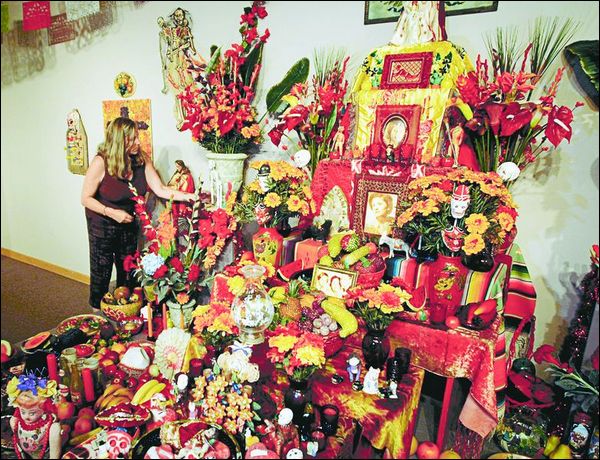
| Photo: Kevin Hoffman/The Coloradoan Laurie Zuckerman places the final touches on her altar 'Forbidden Fruit' on display at the Loveland Museum and Gallery. The altar is a memorial to her mother Blanche Zuckerman. |
| "Grave Matters - The Art of Memory and Mourning" Loveland Art Museum and Gallery, Loveland, CO |